When is a Mole Dangerous?
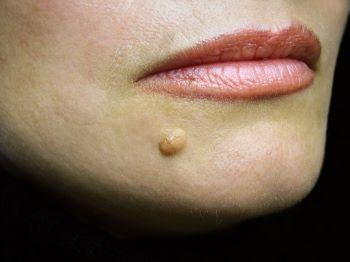
Do you have a mole? Chances are good that you have few of them, actually. The average person has around 30-40 moles, and while moles are usually nothing to worry about it is important to be able to spot any changes that could be warning signs of skin cancer. That’s why you should perform self-exams every month to check the state of your moles. Just because they could be harmless doesn’t mean you should ignore them.
A mole that develops after the age of 30, a mole that bleeds or a changing mole could be a sign of melanoma, a deadly form of skin cancer. This is why it’s important to check your moles regularly. When found early, melanoma is highly treatable. When it comes to pinpointing melanoma your dermatologist may teach you about the ABCDE's of skin cancer:
Asymmetry: If you were to draw a line down the middle of a mole both sides would be completely symmetrical; however, an asymmetrical mole could be a sign of melanoma.
Border: Melanoma is more likely to produce growths that have jagged or poorly defined edges.
Color: Healthy moles are usually a single color, while melanoma will often contain different colors or dark spots.
Diameter: Most healthy moles are smaller than a pencil eraser. If you notice that one or more moles are getting bigger you should speak to your dermatologist.
Evolution: Moles stay relatively the same over time; therefore, if you notice any changes to the size, color, shape, or texture then it’s time to consult with a skincare professional.
Of course, melanoma isn’t the only type of skin cancer to be on the lookout for. The two most common types of non-melanoma skin cancers include basal cell carcinomas and squamous cell carcinomas. Basal cell carcinomas often present as waxy-looking pale bumps on the skin, often on the head or neck, while squamous cells feel like firm nodules that may be smooth at first but become scaly.
Even if you aren’t noticing changes in your moles it’s still a good idea to schedule a skin cancer screening with your dermatologist once a year. Those at an increased risk for skin cancer may want to discuss coming in more often for exams. This exam is non invasive and could just save your life. If you’ve never had a skin cancer screening before it’s high time that you scheduled one.
When is a Mole Dangerous?
Do you have a mole? Chances are good that you have few of them, actually. The average person has around 30-40 moles, and while moles are usually nothing to worry about it is important to be able to spot any changes that could be warning signs of skin cancer. That’s why you should perform self-exams every month to check the state of your moles. Just because they could be harmless doesn’t mean you should ignore them.
A mole that develops after the age of 30, a mole that bleeds or a changing mole could be a sign of melanoma, a deadly form of skin cancer. This is why it’s important to check your moles regularly. When found early, melanoma is highly treatable. When it comes to pinpointing melanoma your dermatologist may teach you about the ABCDE's of skin cancer:
Asymmetry: If you were to draw a line down the middle of a mole both sides would be completely symmetrical; however, an asymmetrical mole could be a sign of melanoma.
Border: Melanoma is more likely to produce growths that have jagged or poorly defined edges.
Color: Healthy moles are usually a single color, while melanoma will often contain different colors or dark spots.
Diameter: Most healthy moles are smaller than a pencil eraser. If you notice that one or more moles are getting bigger you should speak to your dermatologist.
Evolution: Moles stay relatively the same over time; therefore, if you notice any changes to the size, color, shape, or texture then it’s time to consult with a skincare professional.
Of course, melanoma isn’t the only type of skin cancer to be on the lookout for. The two most common types of non-melanoma skin cancers include basal cell carcinomas and squamous cell carcinomas. Basal cell carcinomas often present as waxy-looking pale bumps on the skin, often on the head or neck, while squamous cells feel like firm nodules that may be smooth at first but become scaly.
Even if you aren’t noticing changes in your moles it’s still a good idea to schedule a skin cancer screening with your dermatologist once a year. Those at an increased risk for skin cancer may want to discuss coming in more often for exams. This exam is non invasive and could just save your life. If you’ve never had a skin cancer screening before it’s high time that you scheduled one.

Ormond Beach
400 Lakebridge Plaza Drive
Ormond Beach, FL 32174
Phone: (386) 677-9044
Ormond Beach
1385 West Granada Blvd., Ste 1
Ormond Beach, FL 32174
Phone: (386) 677-9044
Port Orange
1175 Dunlawton Avenue, Unit 102
Port Orange, FL 32127
Phone: (386) 265-1913
New Smyrna Beach
501 South Orange Street
New Smyrna Beach, FL 32168
Phone: (386) 410-5045
Palm Coast
33 & 37 Old Kings Road North
Palm Coast, FL 32137
Phone: (386) 225-4607
Orange City
2515 Junior Street
Orange City, FL 32763
Phone: (386) 218-6806