
Dental Bridges Melrose, MA

Regain Strong, Functioning Teeth at Pan Dental Care
When a tooth is weakened due to previous root canal treatment or fracture, it is often recommended by your dentist to have a crown made in order to strengthen the tooth and protect it from further injury. Esthetic, custom-made dental crowns and bridges are available here at Pan Dental Care in Melrose, MA for revitalizing your confident, healthy smile.
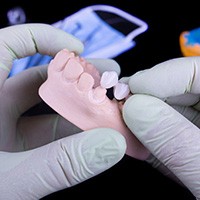
What are Dental Bridges?
Dental bridges contain multiple prosthetic teeth that are designed to fill in the space(s) left by one or multiple lost teeth in a row, effectively “bridging” their gap. Traditionally, they are anchored sturdily in place with the help of additional dental crowns, which are placed over adjacent healthy teeth. However, this treatment does require the removal of healthy tooth structure. That is why our Melrose dentists now strongly recommend opting for single dental implants or an implant-retained dental bridge to restore empty spaces while preserving the other existing teeth that lie adjacent to the space.
Implant-retained bridges have the same basic design as traditional bridges, but they are anchored in place over two dental implants that are directly inserted into the jawbone. As a result, the patient’s oral health is better preserved and natural teeth don’t have to be majorly altered to accommodate the new restoration.
Why Choose Pan Dental Care in Melrose, MA For A Bridge?
If you are looking for beautiful dental restorations such as dental bridges, you shouldn't go to just any dentist. Here are some reasons why Pan Dental Care is the best choice for dental bridges in the Melrose area:
- Emax, Zirconia and Ceramics for Outstanding Aesthetics
- Dental Implants Available In-Office from Start to Finish
- Advanced-Trained Dentists & Decades of Proven Experience
Benefits of A Dental Bridge
Dental bridges offer patients numerous valuable benefits:
- Renewed biting strength and function
- Avoidance of natural teeth from tilting and shifting out of position
- Maintenance of patients’ natural facial shape and appearance
- Improvement of overall self-confidence
Types of Bridges
There are four common types of dental bridges, and the type of bridge that is best for you will depend on your preferences, your oral health, and the location and number of missing teeth. Because a bridge requires healthy teeth, gums, and bone for a long-lasting and successful restoration, our Melrose dentists will address any existing dental problems beforehand.

Traditional Bridge
Traditional bridges are fixed in place and are anchored by crowns placed on the healthy teeth on each side of the gap. First, the two supporting teeth, known as abutment teeth, are prepared for crowns. This requires removing part of the tooth structure and creating an impression of each tooth. Crowns are created from these impressions and are attached on each side of the artificial tooth, creating the bridge. The crowns are then cemented to the prepared teeth, securing the entire bridge unit in place.

Cantilever Bridge
A cantilever bridge is used when there aren’t teeth available on both sides of the missing tooth to serve as abutment teeth. In this case, a healthy tooth on one side of the gap can be fitted with a crown to hold a single pontic. Because the pontic is only attached on one side, cantilever bridges aren’t recommended for the rear of the jaw, where chewing forces are much more powerful and the extra stress can damage the abutment tooth over time.

Maryland Bridge
A Maryland bridge is a less invasive treatment than a traditional bridge because there is no need for crowns to hold the bridge in place. A pontic is created with two wings made of resin, porcelain, or metal attached to its back. These wings are then bonded to the backs of the two abutment teeth. This type of fixed bridge is often used to replace one or two front teeth; it’s not strong enough to replace molars. Because no crowns are necessary, a Maryland bridge is generally more cost effective than other options.

Implant-Supported Bridge
An implant-supported bridge is a bridge attached to dental implants. Implant posts are surgically embedded in the jawbone and then, over a period of months, fuse with the bone. This fusion provides an exceptionally strong foundation for a bridge. It is more beneficial to consider an implant-supported bridge for several missing teeth, or if the teeth adjacent to the area do not need restorations.
Dental Bridge Procedure
Dental bridges are a great way to replace missing teeth. Your existing teeth are used to literally create a bridge to cross the area where your tooth is missing. Bridges are made from gold, metal, alloys, or porcelain to ensure that they are strong and durable.
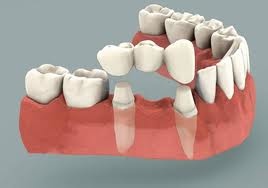
The process of creating a bridge begins by creating abutments out of your existing teeth where the bridge will be attached. The existing teeth are recontoured to provide a base for the bridge. After the abutments have been created, a mold is taken of the area which is sent to a dental lab. The lab is able to use the mold to create a bridge that will fit properly and feel as close to your natural teeth as possible. The bridge consists of two crowns on either end to place on the abutments and a pontic, which is the new tooth that replaces your missing tooth.
We will fit you with a temporary bridge while we wait for the lab to craft your permanent bridge. This will protect the abutments and the exposed gum areas and look more appealing than having a missing tooth. When the permanent bridge has been created, you will have a follow up visit to set the bridge. It will be placed on the abutments and the dentist will then use an adhesive to make sure that the bridge is set.
The bridge may take a little while to get used to, but after a few days it should feel like you have your own teeth back again. You should eat soft foods for the first few days after having your bridge placed. After the initial phase, you will be able to eat whatever you want with no issues.
If you are missing a tooth you should strongly consider having it replaced. Besides the aesthetic disadvantage of missing a tooth, it could also cause structural changes to your mouth and jaw, as well as making it difficult to eat or speak properly. Set up an appointment today to restore your smile.